
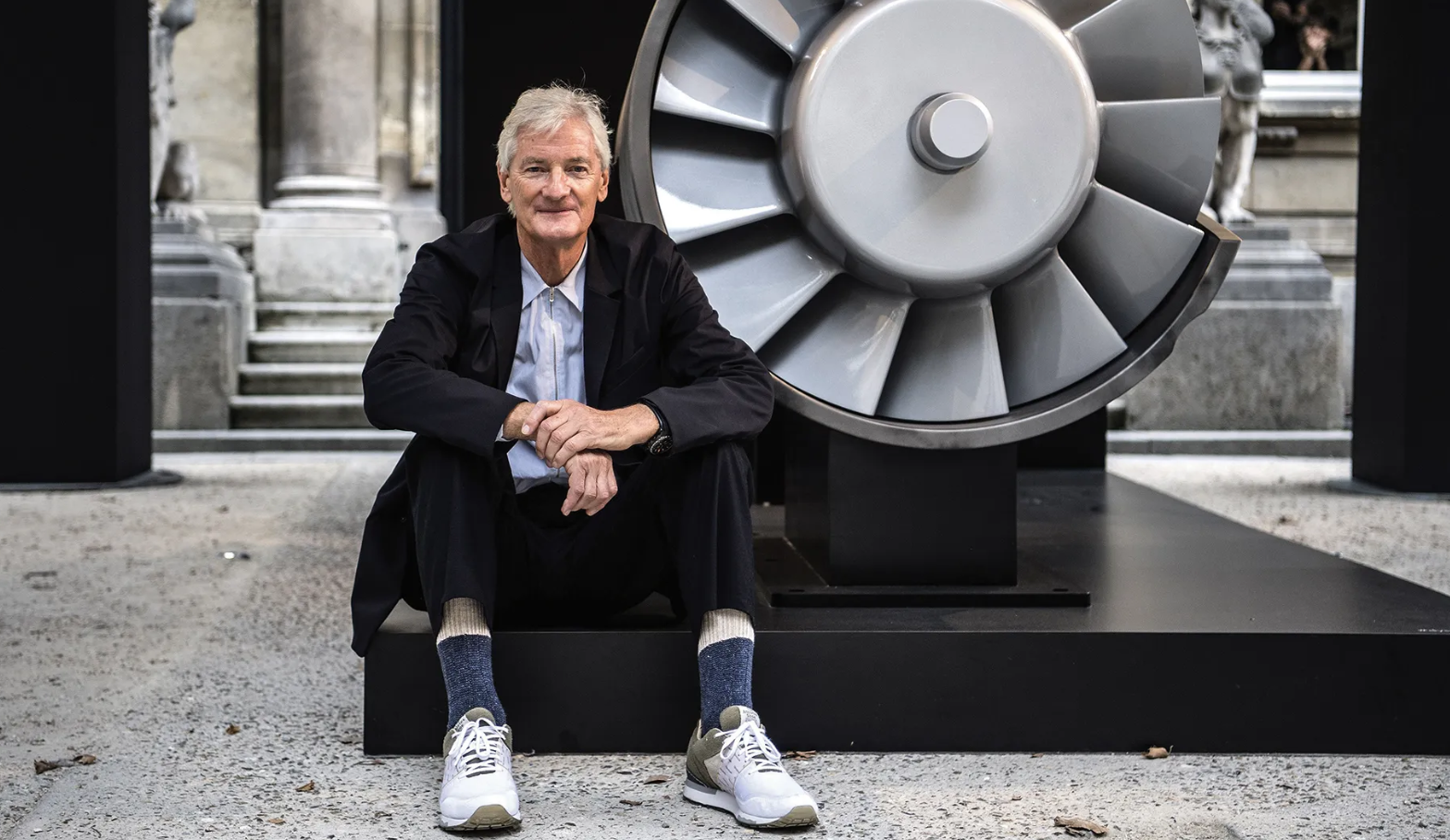
James Dyson is a British inventor, industrial designer, entrepreneur, and engineer best known for developing bagless vacuum-cleaning technology and building Dyson into an internationally recognized technology company. His career has been shaped by a belief that familiar everyday products can often be redesigned through engineering, experimentation, and persistence. From vacuum cleaners to hand dryers, fans, air-treatment products, and hair-care technology, Dyson’s work has focused on applying engineering principles to consumer products that many people previously considered technologically mature.
Born in Cromer, Norfolk, England, in 1947, Dyson grew up in Britain during the post-war period. He later studied at the Byam Shaw School of Art before attending the Royal College of Art, where his interests increasingly moved toward design and engineering.
This combination of art, industrial design, and engineering became important to his later approach. Rather than treating appearance and mechanical function as completely separate disciplines, Dyson developed products in which the engineering itself frequently became part of the visual identity.
His early professional work included involvement in the development of the Sea Truck, a high-speed landing craft. He later created products of his own, including the Ballbarrow, a redesigned wheelbarrow that replaced the traditional narrow wheel with a ball intended to improve maneuverability.
The Ballbarrow demonstrated an idea that would recur throughout Dyson’s career: instead of accepting the established design of an everyday object, he would identify a functional weakness and attempt to redesign the product around that problem.
The invention most strongly associated with his name began with frustration over vacuum cleaners. Traditional machines used bags to collect dust, but Dyson observed that suction performance could decline as the bag filled and its pores became clogged. He began investigating whether cyclonic separation, a principle used in industrial environments, could be adapted for domestic vacuum cleaners.
Developing a workable product was not a quick process. Dyson famously produced thousands of prototypes while refining his design. This prolonged experimentation became central to the story of his career and to the philosophy later promoted by his company: failure during development should be treated as information rather than as a reason to abandon an idea.
The resulting vacuum-cleaning system used cyclonic forces to separate dust from airflow without relying on a conventional disposable bag. Although the concept eventually became commercially successful, persuading established manufacturers to adopt it proved difficult.
Dyson ultimately pursued commercialization more independently. His vacuum cleaners achieved success first in overseas markets and later in Britain, where the company’s distinctive designs and emphasis on engineering helped differentiate the products from established competitors.
The transparent dust container became one of the company’s recognizable design elements. Conventional wisdom suggested consumers might prefer not to see collected dirt, but Dyson’s machines made the process visible. The feature provided an immediate demonstration of what the product had removed while reinforcing the impression that the engineering itself was part of the product experience.
As the business expanded, Dyson moved beyond vacuum cleaners. The company invested heavily in motors, airflow, filtration, acoustics, battery technology, robotics, and other engineering disciplines. These capabilities allowed it to enter product categories that initially seemed unrelated to floor cleaning.
The Dyson Airblade hand dryer became one example. Instead of relying primarily on heated air, the device used high-speed sheets of air to remove water from hands. The product reflected the company’s broader emphasis on airflow engineering and high-speed motors.
Dyson later entered the fan and air-treatment market with products designed around unconventional airflow systems. Air purifiers, heaters, and related devices expanded the company’s presence within household environmental technology.
Perhaps one of the most surprising expansions came in personal care. The Dyson Supersonic hair dryer applied the company’s experience with compact digital motors and controlled airflow to hair drying. The Airwrap subsequently used aerodynamic effects to style hair, demonstrating how engineering research developed for one category could be adapted to another.
These products helped transform Dyson from a company primarily associated with vacuum cleaners into a broader premium technology brand. The strategy also demonstrated the commercial value of maintaining internal expertise in fundamental technologies rather than developing each new product category independently.
Research and development remain central to the company’s identity. Dyson has invested substantial resources in engineering facilities and employs specialists across numerous scientific and technical disciplines. Product development can involve years of testing before a device reaches consumers.
James Dyson has frequently emphasized the importance of engineering education. Concerned about shortages of engineers and technical specialists, he established educational initiatives intended to encourage young people to pursue engineering and design.
The James Dyson Foundation supports engineering education and promotes problem-solving among students. The James Dyson Award, an international design competition, gives young inventors and engineers opportunities to present solutions to real-world problems.
Dyson has also established the Dyson Institute of Engineering and Technology, reflecting his interest in combining academic education with practical engineering experience. His broader argument has been that engineering skills are essential for innovation, productivity, and solving complex societal problems.
Like many highly successful business figures, Dyson has also attracted criticism and controversy. Discussions have surrounded manufacturing decisions, corporate structure, political views, taxation, and the geographical organization of the company. These debates form part of the wider public conversation about multinational businesses and the responsibilities of prominent entrepreneurs.
His support for Brexit also made him a visible participant in one of Britain’s most divisive political debates. Dyson argued that leaving the European Union could create economic and commercial opportunities, while opponents strongly challenged that assessment. His involvement demonstrated how prominent business leaders can become influential voices in political discussions even when they do not hold elected office.
Another ambitious chapter involved the company’s attempt to develop an electric vehicle. Dyson invested considerable resources in the project before eventually deciding that the vehicle could not be made commercially viable. Rather than resulting in a consumer car, the project was discontinued.
The decision illustrated an important aspect of innovation: even organizations with substantial engineering expertise and financial resources cannot guarantee that every project will succeed commercially. Dyson nevertheless argued that knowledge gained from areas such as batteries and electronics could support other technological development.
The story of James Dyson is therefore not simply about one successful vacuum cleaner. It is about a particular philosophy of product development built around identifying frustrations, testing possible solutions, learning from unsuccessful prototypes, and challenging assumptions about mature product categories.
His influence can be seen in the way modern consumer technology increasingly emphasizes engineering as part of branding. Products that were once treated primarily as household appliances can now be marketed around motors, aerodynamics, filtration systems, sensors, and sophisticated materials.
From his early experiments with industrial design to the creation of a global technology business, Dyson has spent decades arguing that ordinary objects are rarely beyond improvement. Whether one considers his vacuum cleaners, educational initiatives, ambitious research projects, or unsuccessful experiments, persistence remains a recurring theme.
Today, James Dyson is one of Britain’s best-known inventors and entrepreneurs. His career demonstrates how engineering, design, business strategy, and a willingness to challenge established products can combine to create an international brand. More broadly, his work has helped make engineering itself visible to millions of consumers, turning the mechanisms inside everyday products into a central part of how those products are understood and valued.
Want to know more?
Buy a copy of this newspaper to read the full story.